
Dentrix Notes & Documentation Tips (Replay): Where Should Your Dental Team Make Notes?
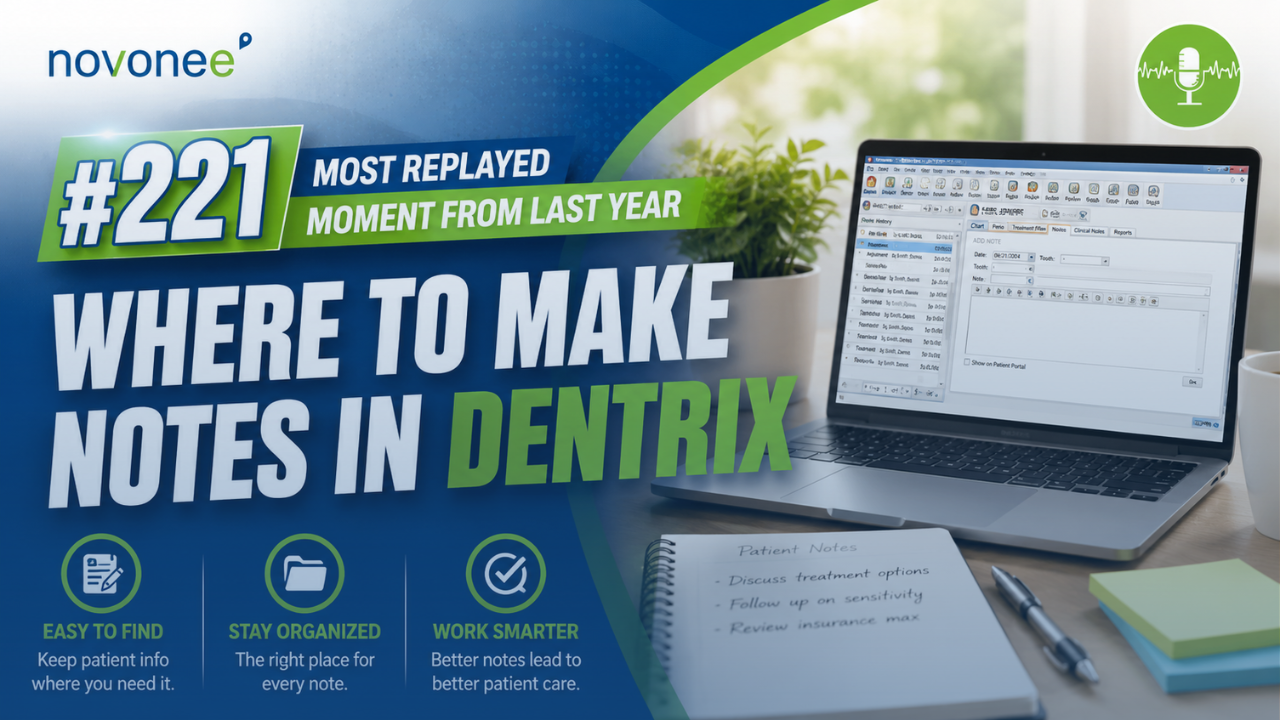
In case you missed it, I’m replaying one of last year’s most viewed and listened-to podcast episodes because this question comes up in almost every practice I work with:
“Where should we make this note in Dentrix?”
With so many places to document information, having a clear system can make a huge difference in how efficiently your team communicates and works together.
Listen on Apple Podcasts:
Listen on SoundCloud:
Do You Have a Dentrix Documentation System?
Think about this scenario.
A patient calls and says:
“Susie called me yesterday, but I’m not sure why.”
Susie isn't working today.
Can someone else on your team quickly figure out why she called?
If the answer is no, you may not have a Dentrix problem. You may have a documentation system problem.
Dentrix gives your team several places to document information. The challenge isn't simply knowing that those places exist—it's knowing what information belongs where and making sure everyone on your team follows the same process.
Here are a few places to start.
1. Appointment Book Notes: Keep Scheduling Information Where It Belongs
Let's start where most teams start their day: the Appointment Book.
The daily note in the upper-left corner is specific to that day, not a patient. I love using it for things like:
- Morning huddle information
- Daily production goals
- Team reminders
- New patient openings
- Team celebrations or events
You also have the appointment note, which should contain information specific to that particular appointment.
Maybe the patient owes a copay today. Maybe they mentioned a sensitive tooth. Maybe they can only come in after 2:00 if you're trying to move them up from the ASAP List.
The important thing is that the information belongs to that appointment.
When your team understands this distinction, information becomes much easier to find when someone else needs it.
2. Family File Notes: Keep Patient and Insurance Information Separate
The Family File gives your team another important place to document information.
For example, the Patient Note can be useful for relationship-building information such as:
- Hobbies
- Pets
- Children
- Vacations
- Personal preferences
These little details can help your team build stronger patient relationships.
But remember: not every piece of information belongs in a general patient note.
Insurance information, for example, has its own place. Plan-specific information such as frequency limitations, age limitations, and coverage provisions should be documented where the entire team can find it when they need it.
The key is understanding the difference between patient-specific information and plan-specific information.
3. The Office Journal: Don't Lose Your Patient Communication History
If there is one Dentrix documentation tool I want your entire team to feel comfortable using, it's the Office Journal.
When your team contacts a patient about things like:
- Unscheduled treatment
- Overdue continuing care
- Scheduling
- Financial questions
- Other non-clinical communication
That interaction should be documented so the next person who speaks with the patient has the information they need.
This is how you start solving the:
“Susie called me yesterday, but I don't know why.”
problem.
Instead of relying on sticky notes, handwritten lists, or someone's memory, your team has a centralized communication history they can reference.
But Those Aren't the Only Places to Document in Dentrix
And this is where things get interesting.
Dentrix has many different places where your team can document information, and each one has a different purpose.
The goal isn't to memorize every location.
The goal is to create a simple documentation standard your entire team can follow.
Because when everyone knows what goes where, you spend less time searching for information and more time taking care of your patients.
Want the Complete List?
I've put together a free “Where to Make Notes in Dentrix” Tip Sheet that breaks down the different places your team can document information and what each one should be used for.
Use it as a quick reference for your team and start creating a more consistent Dentrix documentation system.
The Bottom Line
Good documentation isn't about creating more notes.
It's about putting the right information in the right place so the next person can find it when they need it.
When your team follows the same system:
- New team members can onboard faster
- Virtual team members can find information more easily
- Patient phone calls become easier to manage
- Treatment follow-up can improve
- Insurance communication becomes clearer
- Your team spends less time searching for answers
Your Dentrix software already gives you the tools.
Now your team needs an agreed-upon system for using them.
Want to see all the recommended note locations?
👉 Download the free “Where to Make Notes in Dentrix” Tip Sheet.
Related Resources
Want to build stronger Dentrix systems in your practice?
Building Rock-Solid Dentrix Workflows: Daily, Weekly, and Monthly Systems That Actually Work
Dentrix Paperless Workflows: Replacing Printed Reports With Live Dentrix Tools
Dentrix Treatment Manager: Increase Case Acceptance and Recover Unscheduled Treatment
Stay connected with news and updates!
Join our mailing list to receive the latest news and updates from our team.
Don't worry, your information will not be shared.
We hate SPAM. We will never sell your information, for any reason.